Historical Interpretations of Greene County Weems DNA
Introduction:
Before I proceed with analyzing the autosomal DNA of more Abbeville Weems descendants, I'd like to address one of the biggest ongoing mysteries encountered during my research so far - the parentage of John Weems, who first appeared in Orange County, NC around 1767 with his wife Catherine or "Kitty", and then moved to Greene County, TN with all of their children in the 1790s. Neither John nor Kitty's exact birth years or family origins are known for certain, but family tradition says John was born between 1740 and 1745. Their oldest child is believed to have been born around 1765, so these birth years are certainly plausible, although John also could have been slightly older.
The identity of John's parents and exactly how or if he might be related to the Abbeville Weems family has long been the subject of arduous research and speculation. Notably, both Y-DNA and autosomal DNA test results in recent years seem to prove there was in fact a relatively close connection, but no one has been able to reach any definitive conclusions. Specifically, these two lineages appear to share a relatively recent male ancestor in common, but the identity of that ancestor has yet to be determined. Over the years, I've seen theories proposed in many different directions, all involving a healthy amount of guesswork due to the scarcity of records from the time period in question.
First, let's briefly get into the details of the Y-DNA results of both groups. Multiple direct male line descendants of John Weems (of Greene County, TN) belong to the haplogroup R-BY189912. Multiple direct male line descendants of Thomas Weems (of Abbeville, SC) belong to the haplogroup R-BY191716.
The R-BY189912 haplogroup (TN Weems) was formed when it branched off from the R-BY191716 haplogroup (SC Weems), making the two relatively closely related. In other words, a unique genetic mutation occurred in an ancestor of the Greene County, TN Weems male line which did not occur in the Abbeville, SC Weems male line. This means that even though the two male lines belong to different haplogroups, they are likely descended from the same male lineage at some point in the recent past.
FamilyTreeDNA gives some additional statistical information about these haplogroups. Based on the available genetic data, there is a 95% confidence level that the former haplogroup (TN Weems) branched off from the latter haplogroup (SC Weems) between the years 1235 and 1735 CE/AD. Of course, this doesn't tell us exactly how the two groups are related, but it does show there is a strong possibility that the connection could be traced within the span of written history, and perhaps even to around the time their families were migrating to America. These haplogroups also show that the most closely related surnames are Scottish in origin, such as Buchanan and MacGregor.
The R-BY189912 haplogroup (TN Weems) was formed when it branched off from the R-BY191716 haplogroup (SC Weems), making the two relatively closely related. In other words, a unique genetic mutation occurred in an ancestor of the Greene County, TN Weems male line which did not occur in the Abbeville, SC Weems male line. This means that even though the two male lines belong to different haplogroups, they are likely descended from the same male lineage at some point in the recent past.
FamilyTreeDNA gives some additional statistical information about these haplogroups. Based on the available genetic data, there is a 95% confidence level that the former haplogroup (TN Weems) branched off from the latter haplogroup (SC Weems) between the years 1235 and 1735 CE/AD. Of course, this doesn't tell us exactly how the two groups are related, but it does show there is a strong possibility that the connection could be traced within the span of written history, and perhaps even to around the time their families were migrating to America. These haplogroups also show that the most closely related surnames are Scottish in origin, such as Buchanan and MacGregor.
Based on circumstantial evidence from the limited historical records and a cursory understanding of the DNA connections, the simplest, most obvious explanation might be that this John Weems was the oldest son of Thomas Weems Senior (born 1704) and Eleanor Jacobs (born 1710). However, this is a pretty huge leap to make without direct evidence. Although other researchers have considered this explanation somewhat plausible or even highly probable, I'd like to take a much closer look and examine all of the available facts to determine exactly how likely this relationship might be, especially compared to other possible relationships. I will also be delving into the details of the autosomal DNA matches towards the end of this post, hoping to fill in some missing pieces.
Available Records:
Just to review the basics - we know that Thomas Weems Senior and Eleanor Jacobs were married on November 6, 1728, and according to Cecil County, Maryland church records, their first two children were named Isabella (born on December 7, 1729) and John (born on November 6, 1731). Undoubtedly, they had several additional children born after this (from 1732 until around 1750), but their exact birth years and names cannot be found in any surviving records from this period. The family lived in Cecil County until the mid-1740s, then moved to
Augusta County, Virginia until about 1763 when their land was sold. By this time, their oldest son John would have been 31, and presumably some of their other sons would have been in their late 20s. Unfortunately, other than a handful of land records and jury lists for
Thomas Weems himself which only mention his name, there aren't any surviving records for any of his sons in Augusta County, Virginia - with one notable exception.
There was actually one single mention of a man named John Weems living in Augusta County, VA, and he was listed receiving payment among several other young men whose surnames trace back to the Calfpasture River area where Thomas and Eleanor lived.


Chronicles of the Scotch-Irish Settlement in Virginia, Volume I
Extracted from the Original Court Records of Augusta County, 1745 - 1800
by Lyman Chalkley, Published by Mary S. Lockwood
www.familysearch.org/library/books/idviewer/202922/527
This record appears to be dated 1755/56/57. It is significant because it is the only Augusta County record from this era which directly mentions any individual with the surname Weems besides Thomas and Eleanor. Also noteworthy on the same list are the surnames Hamilton, Gillespie, Lewis, Miller, Gay, Stevenson, and Kinkead, which all seem to correspond with other families who were living in the Calfpasture River area alongside the Weems' property. Several of these names would also show up later in Abbeville, SC. Listed as a witness towards the end of the document was William Preston, signing for his uncle James Patton, prominent speculator who sold land to the original settlers of the Calfpasture River area, including Thomas Weems. At the very least, this is fairly strong evidence that the same John Weems born in Cecil County, MD in 1731 (the oldest son of Thomas and Eleanor) lived to adulthood and remained in or near Augusta County until his mid-20s or later.
However, there is no direct evidence to show that this same John Weems moved to the Abbeville, SC area like the other children of Thomas and Eleanor, since no land records can be found for him. Between 1765 and 1800, there are land records in South Carolina for Thomas Weems (multiple entries possibly for separate individuals), along with Henry, James, George, Bartholomew, and William Weems, but notably there is no John Weems whatsoever.
Additionally, there are no wills or estate records for a John Weems in Abbeville. This is another notable exception, since these records exist for Thomas, Henry, Bartholomew, and William. These records cannot be found for George, because he moved out of state, and they also cannot be found for James, possibly for the same reason. However, in both of these cases, a sufficient number of other records exist to show they absolutely did live in Abbeville during the late 1700s. With the exception of the 1790 and 1800 federal censuses, no such records can be found for any John Weems, especially not one who could plausibly be born as early as 1731.
Additionally, there are no wills or estate records for a John Weems in Abbeville. This is another notable exception, since these records exist for Thomas, Henry, Bartholomew, and William. These records cannot be found for George, because he moved out of state, and they also cannot be found for James, possibly for the same reason. However, in both of these cases, a sufficient number of other records exist to show they absolutely did live in Abbeville during the late 1700s. With the exception of the 1790 and 1800 federal censuses, no such records can be found for any John Weems, especially not one who could plausibly be born as early as 1731.
Now, here's where the real confusion starts. On the 1790 census,
there were in fact two heads of household named John Weems living in Abbeville
County. It's a pretty safe bet that one of them (born around 1762) must have been the oldest son of Bartholomew Weems, although some sources have erroneously
listed him as the son of Thomas and Eleanor. He served in the
Revolutionary War as a young man, married Margaret Stephenson, and eventually moved to Smith County,
Mississippi. The other John Weems was listed on the same page just one household away
from Thomas Weems Jr, and he has never been conclusively
identified.

1790 US Federal Census
Abbeville County, SC
(Page 9 of 12)
Abbeville County, SC
(Page 9 of 12)
Many online family trees and unreliable sources seem to have assigned the middle name John to Thomas and Eleanor's son Bartholomew Weems, but there is no evidence for this. Some have even gone so far as to claim that Bartholomew was the very same John Weems born in Cecil County, MD in 1731, which also lacks evidence. We do know that Bartholomew was likely born in the 1730s based on the ages of his children, and we know one of his oldest sons was named John, but there is no reason to think he went by any other name than Bartholomew (or a variation).
I suspect that
the existence of two different men named John Weems on the 1790 census
has led some researchers to conclude that one of them was Thomas and
Eleanor's oldest son John (born in 1731) who actually moved to Abbeville
with the rest of the Weems family. This could be correct, but there are other possibilities which cannot be ruled out. Besides John and Bartholomew, it's almost certain that some of Thomas
and Eleanor's other sons must have been born in the 1730s, making one or more of them old enough to start having children
by the early 1750s. So, the second John Weems on the 1790 census could easily be a grandchild of Thomas and Eleanor, with no real indication he was the John Weems born in 1731.
Additional Historical Context:
The town of Hillsborough, where John Weems lived in Orange County, NC is only about 170 miles south of the Calfpasture River area in Augusta County, VA where Thomas and Eleanor lived until 1763. We know that the record trail for this John Weems begins with a land purchase in Orange County, NC in February 1767, so it's certainly within the realm of possibility that he moved to NC from Virginia shortly before this.Interestingly, the first Abbeville land record for a Thomas Weems was in August 1767. Remember, this was just four years after Thomas and Eleanor sold their land in Augusta County, VA. So far, this John Weems seems to fit perfectly into the timeline of his possible parents (Thomas and Eleanor) leaving Augusta County with their children. Perhaps the oldest son (John) stayed in NC, while the rest of the family migrated further south. Is this just a coincidence or does it show that they were all part of the same family moving together?
John Weems sold his land in Orange County, NC in December 1790, and at least two of his sons were still living in the area when they got married in March and October 1791. John Weems then purchased land in Greene County, TN in February 1792. By this time, Thomas and Eleanor's known descendants were well established in Abbeville, having lived there since the early years of the Long Cane settlement and throughout the Revolutionary War.
We can say for certain during this time period (mid-1700s through early 1800s) that there were definitely groups of families who migrated from Augusta County, VA to both Orange County, NC and Abbeville County, SC, and possibly from all three of these locations to Greene County, TN. Some of these individuals might have even had a loose connection to the Weems families (cousins of cousins or in-laws, for example.) In previous posts, I touched on the early religious associations of the Weems family. What all of these places have in common is that they were largely settled by Scotch-Irish Presbyterians who wanted nothing to do with the Church of England. They were all considered the frontier or backwoods settlements, far away from the government and mostly autonomous, at least for a brief period of time.
Migrating from Orange County, NC to Greene County, TN in the early 1790s required traveling on a limited number of major inland wagon roads which ran roughly parallel to the coastal King's Highway. Hillsborough in Orange County was located along the Upper Road (or Piedmont Road), which ran from Fredericksburg, VA through the middle of North Carolina to Upstate South Carolina, then to Georgia.
Western North Carolina is separated from East Tennessee by the Blue Ridge Mountains, which were still relatively difficult to cross at this time. For most settlers, Greene County, TN could only be accessed via two routes - either the Great Wagon Road (or Great Valley Road) from Virginia, or alternatively from Upstate South Carolina via the Catawba Trail. This was the primary path of North and South Carolina pioneers headed west to Tennessee, and one of the only established routes through the Blue Ridge Mountains.
In other words, there is a decent chance that the route John Weems and his children took to get to Greene County, TN was through upstate South Carolina. They could have come within 50 miles of Abbeville, and within roughly 20 miles of nearby Pendleton where some Weems descendants (George Weems and Rachel Weems Lawrence) were living by 1790. Whether or not they were aware how close their relatives were living is not known. There isn't any direct evidence John had contact with any extended family after first settling in North Carolina, much less if he still maintained contact decades later. Alternatively, it's possible John Weems went north through Virginia or took a "short cut" through one of the various gaps in the mountains, and therefore never came in close proximity to upstate SC, but these routes would have been more difficult for a large family.
In other words, there is a decent chance that the route John Weems and his children took to get to Greene County, TN was through upstate South Carolina. They could have come within 50 miles of Abbeville, and within roughly 20 miles of nearby Pendleton where some Weems descendants (George Weems and Rachel Weems Lawrence) were living by 1790. Whether or not they were aware how close their relatives were living is not known. There isn't any direct evidence John had contact with any extended family after first settling in North Carolina, much less if he still maintained contact decades later. Alternatively, it's possible John Weems went north through Virginia or took a "short cut" through one of the various gaps in the mountains, and therefore never came in close proximity to upstate SC, but these routes would have been more difficult for a large family.


Maps of Colonial Roads
https://www.familysearch.org/en/wiki/Upper_Road
https://www.familysearch.org/en/wiki/Catawba_Trail
I entertained the possibility that John Weems (NC/TN) and/or some of his sons did actually live in Abbeville County, SC (or nearby Pendleton) for a brief period of time before moving to Tennessee, but I can't find any evidence for this. It could explain some of the unknown Weems households appearing on the census, but at this point I think it's very unlikely. The dates just don't seem to work out.
Autosomal DNA Results:
Unless some crucial records are uncovered, it seems that the only hope of determining the relationship between John Weems (NC/TN) and Thomas/Eleanor Weems (VA/SC) might come from a careful analysis of the shared DNA between their descendants. In my last post, I explained how I was able to identify approximately 250 Weems descendants among my dad's DNA matches. Since then, this number has increased to just over 400 total Weems descendants. This is largely thanks to the Ancestry Pro Tools Enhanced Shared DNA
Matches feature, which allows you to see the total shared cM amounts
between any given DNA match and your shared matches. Included within this total are 32 individuals I have identified as descendants of John Weems of Greene County, TN, ranging from 8 to 20 cM shared. Looking at the shared matches between these 32 descendants and my dad, I can see that all of them share numerous Abbeville Weems matches in common. These Abbeville matches come from different branches - Bartholomew Weems, Henry Weems, George Weems, and even some of the uncertain branches like Mary Weems Burt, Rachel Weems Lawrence, and James William Weems.
This is very promising, and in my opinion it shows there was in fact a close connection between John and Thomas. To have any measurable autosomal DNA in common between the two groups after so many generations is pretty significant. However, comparing data between numerous descendants of both groups would be ideal before jumping to conclusions. So, I've started doing exactly that. It occurred to me that I would probably learn a lot more about the
overall Weems family tree structure by getting access to the
DNA results of other Weems descendants from various branches. I could
then start cataloguing and analyzing their DNA matches, just like I did
for my dad's. So one by one, I started messaging and asking all of these
distant Weems DNA matches to give permission and share their Ancestry
DNA results with me.
Obviously, older generations would be better since their DNA is closer to
the source, and I was hoping to at least get a few matches from some of
the more evasive or mysterious branches, but any Weems descendant could
potentially be useful. I had to be patient, and I knew the response rate
wouldn't be great, but gradually they started coming in.
To date, I
have been given permission to directly view the DNA results of 31 Abbeville, SC
Weems descendants from various branches, and 4 Greene County, TN Weems
descendants. Over the course of several months, I have spent countless
hours exploring their DNA matches, cataloguing and taking notes.
Each of the 4 Greene County, TN Weems descendants has numerous matches who are Abbeville Weems descendants, with many ranging from 20 cM up to 34 cM shared.
For example:
A 4x great granddaughter of Nancy Agnes Weems and John Young has:
22 matches between 8 and 24 cM who are Abbeville Weems descendants.
A 5x great granddaughter of John Weems Jr and Sarah Jones has:
20 matches between 10 and 34 cM
who are Abbeville Weems descendants.
A 6x great grandson of Sarah "Sally" Weems and Daniel Dugger has:
15 matches between 8 and 23 cM
who are Abbeville Weems descendants.
A 5x great granddaughter of James Weems and Hannah Yeates has:
9 matches between 10 and 21 cM
who are Abbeville Weems descendants.
From the other direction, after a close examination of all 31 of the shared Abbeville Weems descendants' DNA matches, I can say that every single one of them has at least a few DNA matches who are descendants of the Greene County, TN Weems family (John Weems). Combined between all of them, I've counted 147 total descendants of the Greene County, TN Weems family who have submitted their DNA.
For example:
A 5x great grandson of George Weems (b.1750) has:
35 matches between 8 to 25 cM who are Greene County TN Weems descendants.
A 4x great grandson of George Weems (b.1750) has:
20 matches between 8 and 23 cM who are Greene County TN Weems descendants.
A 5x great grandson of Bartholomew Weems (b. ~1735) has:
10 matches between 8 and 24 cM who are Greene County TN Weems descendants.
A descendant of both William Weems (b. ~1770) of Jefferson County, Alabama, and George Weems (b. ~1780) of Pickens County, Alabama has:
7 matches between 14 and 36 cM who are Greene County TN Weems descendants.
A 3x great grandson of George Weems (b. 1750) and a 5x great granddaughter of Henry Weems (b. ~1740) each have:
5 matches between 8 and 20 cM
who are Greene County TN Weems descendants.
If I spent nearly as much time analyzing the matches of these individuals as I have for my father's matches, I'm fairly confident these totals would go up.
So to summarize what I've determined so far, there are numerous Greene, TN Weems descendants who share between 20 and 30 cM with numerous Abbeville, SC Weems descendants. There are even several individuals from the two groups who share as much as 34 - 42 cM, although it's possible some of these could be outliers who are related in other ways.
However, some of the most intriguing DNA results from any Weems descendant I've been given permission to view are from a 2x great granddaughter of James William Weems (born ~1801) who settled in Greene County, Alabama in the early 1820s and married Rachel Ward. (Note: All records I've found simply refer to him as "William Weems" but many of his descendants have consistently referred to him by the full name of "James William Weems". I tend to use the full name to distinguish him from other Williams born around the same time.)
No records can be found which name James William Weems' parents or any other family besides his wife and children. The 1850 census shows that he was born in South Carolina, which was a strong clue that he might have been a descendant of the Abbeville Weems family. Along with numerous other Weems households which first appeared in Georgia and Alabama in the early 1800s, James William Weems has long been considered a "brick wall" or "end of the line" ancestor. For several years now, I've seen enough shared DNA matches between his descendants and other Abbeville Weems branches to be almost certain that he must fit into the family tree somehow.
Once I got the chance to view the DNA matches of his 2x great granddaughter, I immediately noticed a significantly higher number of Weems matches from various branches than any other individual I'm aware of, with many of them sharing more than 30 cM. I'm still in the process of documenting them all, but so far I've identified over 130 descendants of the Abbeville Weems family and over 60 descendants of the Greene County, TN Weems family.
This makes sense because this test subject is in her 80s, and her father was a grandson of the youngest son of James William Weems. This means she is generationally closer to her oldest known Weems ancestor (and theoretically our shared ancestors) than virtually any other DNA test subject I've encountered. The shared DNA amounts between her and other Weems descendants could be extremely valuable for my research. (Of course, for the purposes of this post I am excluding her shared DNA amounts with other descendants of James William Weems, since I am specifically interested in how he relates to the other Weems branches.)
On the higher end, this test subject has the following DNA matches:
No records can be found which name James William Weems' parents or any other family besides his wife and children. The 1850 census shows that he was born in South Carolina, which was a strong clue that he might have been a descendant of the Abbeville Weems family. Along with numerous other Weems households which first appeared in Georgia and Alabama in the early 1800s, James William Weems has long been considered a "brick wall" or "end of the line" ancestor. For several years now, I've seen enough shared DNA matches between his descendants and other Abbeville Weems branches to be almost certain that he must fit into the family tree somehow.
Once I got the chance to view the DNA matches of his 2x great granddaughter, I immediately noticed a significantly higher number of Weems matches from various branches than any other individual I'm aware of, with many of them sharing more than 30 cM. I'm still in the process of documenting them all, but so far I've identified over 130 descendants of the Abbeville Weems family and over 60 descendants of the Greene County, TN Weems family.
This makes sense because this test subject is in her 80s, and her father was a grandson of the youngest son of James William Weems. This means she is generationally closer to her oldest known Weems ancestor (and theoretically our shared ancestors) than virtually any other DNA test subject I've encountered. The shared DNA amounts between her and other Weems descendants could be extremely valuable for my research. (Of course, for the purposes of this post I am excluding her shared DNA amounts with other descendants of James William Weems, since I am specifically interested in how he relates to the other Weems branches.)
On the higher end, this test subject has the following DNA matches:
25 descendants of Greene County, TN Weems family who share between 20 and 42 cM.
20 descendants of George Weems of Abbeville/Pendleton who share between 20 and 41 cM.
16 descendants of Bartholomew Weems of Abbeville who share between 20 and 43 cM.
6 descendants of Henry Weems of Abbeville who share between 21 and 40 cM.
6 descendants of William Weems (born ~1770, lived in Jefferson County, AL) who share between 23 and 46 cM.
6 descendants of Rachel Weems Lawrence who share between 21 and 42 cM.
(This list excludes dozens of matches from each branch who share less than 20 cM. Because they are so numerous, I am choosing to focus on the matches with the highest shared cM amounts, and 20 cM is the threshold for now.)
Unlike any other Weems descendant I've seen, this test subject has DNA matches from each of these different Weems branches as high as 40 - 46 cM. In other words, the test subject with the most Weems DNA I've encountered seems to share roughly just as much autosomal DNA with Greene County, TN Weems descendants as she does with various Abbeville, SC Weems descendants (excluding her own branch). This seems to line up with DNA amounts from the other descendants I've seen, who are generationally more distant.
6 descendants of Henry Weems of Abbeville who share between 21 and 40 cM.
6 descendants of William Weems (born ~1770, lived in Jefferson County, AL) who share between 23 and 46 cM.
6 descendants of Rachel Weems Lawrence who share between 21 and 42 cM.
(This list excludes dozens of matches from each branch who share less than 20 cM. Because they are so numerous, I am choosing to focus on the matches with the highest shared cM amounts, and 20 cM is the threshold for now.)
Unlike any other Weems descendant I've seen, this test subject has DNA matches from each of these different Weems branches as high as 40 - 46 cM. In other words, the test subject with the most Weems DNA I've encountered seems to share roughly just as much autosomal DNA with Greene County, TN Weems descendants as she does with various Abbeville, SC Weems descendants (excluding her own branch). This seems to line up with DNA amounts from the other descendants I've seen, who are generationally more distant.
If I had seen barely any autosomal DNA shared between the two groups, or a significant difference in the amounts shared, I might be able to speculate that John Weems was only distantly related to the Abbeville Weems family. However, from what I've seen so far, it appears that John's descendants share roughly the same amount of DNA with various Abbeville branches as the various Abbeville branches share with each other. Although there are some occasional exceptions to this trend, and some descendants who are too many generations removed to have measurable DNA in common, this seems to hold true across several hundred Weems descendants whose DNA I have examined so far. To put it simply, autosomal DNA connections between the two groups are somewhat common.
This leads to several possibilities, with all indications that John was a close male relative of Thomas. He easily could have been a son of Thomas and Eleanor, but it shouldn't be ruled out that he was perhaps a brother, nephew, or first cousin of Thomas. The key takeaway is that the relationship probably wasn't much more distant than this. If it was more distant, then many of the modern day descendants of the two groups would be approximately 8th - 10th cousins or more, and almost certainly would not show such a high frequency of shared autosomal DNA. If the relationship was as close as father and son or brothers, then the modern day descendants of the two groups would more commonly fall into the range of 6th - 8th cousins. Obviously, we are dealing with amounts which begin to approach the limits of autosomal DNA testing, so the fact that any connection shows up at all is significant. There is consistently enough DNA shared to tell they were related, but not enough to distinguish what their relationship was with any degree of confidence.
The Dutch Weems DNA Connection:
In my last post, I described finding a small cluster of DNA matches among my dad's Weems matches who were all descendants of New York Dutch immigrants Gillis (or Giles) Jansen Mandeville (1626 - 1701) and his wife Elsje (or Eliza) Hendricks (1627 - 1701). I speculated that these matches might somehow be related through Thomas Weems' wife Eleanor Jacobs, who also came from the NY/NJ Dutch community. At the time, I had only identified 5 Mandeville/Hendricks descendants, but this has since expanded to a total of 14 descendants who share between 9 and 31 cM with my dad.
After spending a lot of time comparing matches, I have determined that numerous other Abbeville Weems descendants share similar amounts of DNA with these and other Mandeville/Hendricks descendants. I've confirmed that these Mandeville/Hendricks descendants share between 20 and 46 cM with several dozen descendants of Bartholomew Weems, Henry Weems, George Weems, Rachel Weems Lawrence, and James William Weems. As far as I can tell, descendants of most (if not all) major Abbeville Weems branches have these Mandeville/Hendricks matches in common. This would seem to support my theory that these matches are somehow related through Eleanor Jacobs Weems.
As I have been searching out and cataloguing more of these matches, I have been amazed at the number of Abbeville Weems descendants they have in common. At a certain point, it occurred to me that this might be an excellent way to determine whether John Weems of Greene County, TN was in fact the son of Thomas Weems Senior and his wife Eleanor Jacobs. If he was their son, then at least some of John's descendants should presumably share DNA with at least some of these Mandeville/Hendricks descendants, since descendants from virtually all branches of the Abbeville Weems family appear to share some Mandeville/Hendricks DNA.
So once again I set out on a search, but this time I didn't manage to find what I was looking for. To my surprise, I haven't been able to find a single descendant of John Weems (of Greene County, TN) who shares DNA with any of these Mandeville/Hendricks descendants - and that's extremely significant. This holds true for all 147 of the Greene County, TN Weems descendants I am aware of, including the 4 whose DNA matches I have been given direct access to. I have spent hours over the course of several weeks looking for any TN Weems who show up as DNA matches to these known Mandeville/Hendricks descendants, but they simply aren't there. On a few occasions, I thought I had found one, but they turned out to be related in other ways. In any case, they certainly don't show up with anywhere near the frequency they do for so many of the Abbeville Weems descendants.
Preliminarily, this would seem to suggest that John Weems of Greene County, TN was NOT in fact the son of Thomas Weems Senior and Eleanor Jacobs. However, I am reluctant to draw any hard conclusions without further evidence. I suppose it could be possible that by random chance, somehow this Mandeville/Hendricks DNA was not passed down to John's living descendants, but this would be a notable difference between his descendants and so many of the Abbeville Weems branches. I'm thinking there must be a reason. There is also the possibility that this Mandeville/Hendricks DNA does not actually come from Eleanor Jacobs, but I struggle to explain how else these Dutch DNA segments could be so widespread among Abbeville Weems descendants, yet nonexistent among Greene County, TN Weems descendants.
This has opened up a whole new mystery which needs to be solved. Eleanor Jacobs was supposedly the daughter of Bartholomew Jacobs (Dutch) and his wife Eleanor Douglas (Scottish) who moved from New York to Pennsylvania shortly before her birth. A 1710 Presbyterian church baptism record from Pennsylvania shows they did have a daughter baptized as "Lenae" which researchers have interpreted as a variation of of the name Eleanor. Of course, Eleanor and Thomas Weems having a known son named Bartholomew Weems (a name passed down for several generations) would seem to support this theory. The problem is that there doesn't appear to be any documented relationship between Eleanor's father Bartholomew Jacobs and the Mandeville/Hendricks family.
If I could definitively link this Mandeville/Hendricks family to Bartholomew Jacobs (father of Eleanor Jacobs Weems), then I would feel much more confident about the significance of the Dutch DNA. I've tried to find some connection besides the fact that they both were Dutch and lived in the same area, but as far as I can tell, they don't appear to be related so far. This is based on the available records for these individuals and their ancestors, but it's important to realize that Dutch naming traditions can be difficult to understand for native English speakers. At the time, many Dutch-American families were only beginning to adopt consistent surnames across generations. I have to wonder if maybe there were two different individuals named Bartholomew Jacobs who have been confused for each other, or perhaps on the other side some of the Mandeville or Hendricks ancestors have been misidentified. For now, I am still tentatively assuming this Mandeville/Hendricks DNA comes from Thomas Weems' wife Eleanor, because she is the only known Dutch connection to the Weems family.
So if John was not the son of Thomas and Eleanor, autosomal DNA still shows that at the very least, Thomas and John Weems were relatively closely related. We don't have a
definitive birth year for John, but since we know he married and started
having children around 1765, we can place his birth most likely between
the late 1720s at the earliest, and the mid-1740s at the latest. Although it is technically possible he could have been a full brother or
half brother of Thomas (who was born around 1704), the age difference
makes other relationships much more likely. John could have easily been a
nephew of Thomas, making him a first cousin of Thomas and Eleanor's children, but a more distant relationship would seemingly fail
to explain the autosomal DNA connections. If (and of course that's still a huge if) all of this information is essentially correct, then it shows Thomas Weems Senior (b.1704) possibly had an unknown brother who was the father of John Weems of NC/TN.
John not being the son of Thomas and Eleanor would also mean that their actual oldest son (also named John Weems, born in 1731) has never been documented by genealogists in any significant way. If he had a wife and children, then he might be the second John Weems listed on the 1790 Census in Abbeville, and again on the 1800 census. This would also mean some of the Abbeville Weems descendants with unknown parentage born in the mid-to-late 1700s could be children of this John.
Another Possible DNA Clue:
There is one last area of interest I thought was worth mentioning in regards to the DNA matches of John Weems' descendants. Several years ago, I came across an internet family tree which included a Margaret Weems (born around 1740) married to a Richard Gott (1734 - 1803), who lived in Orange County, NC from at least 1770 through the 1790s. It is believed that this family came from Maryland, although there were possibly multiple individuals named Richard Gott living at this time, so much of their family history is uncertain.
The existence of another Weems in Orange County at the same time as John Weems would certainly be intriguing, but as far as I can tell, there is no actual documentation to show that Richard's wife's maiden name was Weems. After an extensive search, I wasn't able to find a marriage record or any other document which would confirm her maiden name, so for now I have to assume this information comes from personal family knowledge or a source which hasn't been digitized.
I did find that Richard Gott was listed as a witness on several deeds and other records associated with a William Galbraith in Orange County, NC. This very same William Galbraith was the father of Hannah (or Ann) Galbraith who married Thomas Weems, son of John Weems of Orange County, NC. Actually, it appears William Galbraith moved to Greene County, TN around the same time the Weems family did, then later moved to Sumner County, TN. Although this doesn't prove a direct connection between the Weems and Gott families, it does show that they both had some direct association with William Galbraith.
Last year, I noticed that several descendants of John Weems have some autosomal DNA matches who are descendants of Richard Gott and Margaret Weems. Specifically, one particular descendant (a 6x great granddaughter of John) has at least 14 matches who are descendants of Sutton Gott (1764 - 1850, believed to be son of Richard and Margaret). They are distant matches, only sharing between 9 and 25 cM, which would be expected from such a distant relationship. A few other Weems descendants also have a handful of matches who are descendants of Sutton and his possible sister, Martha Gott Doyle. I am currently on the hunt for more.
I also came across a later, more definitive Weems/Gott connection. John R. Young Jr (1804 - 1867) of Greene County, TN was married to Eliza J. Gott (1822 - 1905). Eliza's maiden name is listed on the death certificates of two of their children as Gott, but I haven't been able to find an actual marriage certificate or any records listing her parents' names. John R. Young Jr was the son of Nancy Agnes Weems and John R. Young, and Nancy Agnes Weems was a daughter of John Weems who lived in Orange County, NC at the same time as the Gotts. So in other words, a grandson of John Weems appears to have married a Gott, possibly a descendant of the same Richard Gott.
This leads me to consider the strong possibility that Margaret Weems (wife of Richard Gott) may have been a daughter of Thomas Weems and Eleanor Jacobs, and/or a sister of John Weems. Obviously at this point this is just a loose theory, so I'm looking for more evidence. I reached out to a Gott researcher and shared this theory, but he maintained that the wife of Richard Gott being named as Margaret Weems was likely an error, based on an old Maryland land record between a Weems and a Gott. Obviously, finding evidence she was a Weems would strongly support this theory and add yet another branch to the Weems family tree.
The existence of another Weems in Orange County at the same time as John Weems would certainly be intriguing, but as far as I can tell, there is no actual documentation to show that Richard's wife's maiden name was Weems. After an extensive search, I wasn't able to find a marriage record or any other document which would confirm her maiden name, so for now I have to assume this information comes from personal family knowledge or a source which hasn't been digitized.
I did find that Richard Gott was listed as a witness on several deeds and other records associated with a William Galbraith in Orange County, NC. This very same William Galbraith was the father of Hannah (or Ann) Galbraith who married Thomas Weems, son of John Weems of Orange County, NC. Actually, it appears William Galbraith moved to Greene County, TN around the same time the Weems family did, then later moved to Sumner County, TN. Although this doesn't prove a direct connection between the Weems and Gott families, it does show that they both had some direct association with William Galbraith.
Last year, I noticed that several descendants of John Weems have some autosomal DNA matches who are descendants of Richard Gott and Margaret Weems. Specifically, one particular descendant (a 6x great granddaughter of John) has at least 14 matches who are descendants of Sutton Gott (1764 - 1850, believed to be son of Richard and Margaret). They are distant matches, only sharing between 9 and 25 cM, which would be expected from such a distant relationship. A few other Weems descendants also have a handful of matches who are descendants of Sutton and his possible sister, Martha Gott Doyle. I am currently on the hunt for more.
I also came across a later, more definitive Weems/Gott connection. John R. Young Jr (1804 - 1867) of Greene County, TN was married to Eliza J. Gott (1822 - 1905). Eliza's maiden name is listed on the death certificates of two of their children as Gott, but I haven't been able to find an actual marriage certificate or any records listing her parents' names. John R. Young Jr was the son of Nancy Agnes Weems and John R. Young, and Nancy Agnes Weems was a daughter of John Weems who lived in Orange County, NC at the same time as the Gotts. So in other words, a grandson of John Weems appears to have married a Gott, possibly a descendant of the same Richard Gott.
This leads me to consider the strong possibility that Margaret Weems (wife of Richard Gott) may have been a daughter of Thomas Weems and Eleanor Jacobs, and/or a sister of John Weems. Obviously at this point this is just a loose theory, so I'm looking for more evidence. I reached out to a Gott researcher and shared this theory, but he maintained that the wife of Richard Gott being named as Margaret Weems was likely an error, based on an old Maryland land record between a Weems and a Gott. Obviously, finding evidence she was a Weems would strongly support this theory and add yet another branch to the Weems family tree.
In Conclusion:
Based on historical context, physical proximity, autosomal DNA and Y-DNA evidence, it would appear at least plausible, if not somewhat likely, that John Weems (NC/TN) was the son of Thomas Weems Senior and Eleanor Jacobs. At the very least, he was closely related to Thomas, close enough that a significant number of their living descendants (after 6+ generations) still share segments of DNA in common. However, while a large number of living Abbeville Weems descendants (Thomas/Eleanor) across numerous branches appear to have inherited some Dutch Mandeville/Hendricks DNA (hypothetical through Eleanor), the same cannot be said about any known descendant of John Weems (NC/TN).
Although I was hoping for a more conclusive answer by this point, at the very least I feel that I've made a step in the right direction. Since I try my best to avoid jumping to conclusions without sufficient evidence, especially for such a major "brick wall" ancestor, I still can't responsibly say who John's parents were or how he was related to Thomas. I prefer to think more in terms of statistical likelihoods rather than absolute certainties when it comes to these difficult questions anyway. What I can say, based on all of the available evidence, is that it is more likely that John was a nephew, half brother, or first cousin of Thomas, rather than a son, full brother, or more distant cousin.
Of course, new information could always tip the scale in another direction. If a significant number of descendants of John Weems can find distant DNA matches who are related to Eleanor Jacobs Weems (through the NY/NJ Dutch community), then this might show that John was in fact the son of Thomas and Eleanor. Or alternatively, if the Mandeville/Hendricks DNA matches can be traced to an ancestor besides Eleanor, then all of this would need to be reassessed. I was also hoping to find some potential leads for the surname/father of John's wife Catherine or "Kitty", but I haven't managed to come up with any good candidates just yet. For now, I will keep checking these DNA matches as often as I can for any new clues.

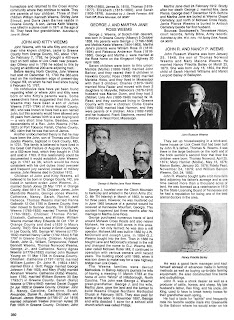
https://www.carolana.com/NC/Revolution/patriots_nc_capt_william_galbreath.html Galbraith and Gott military service during the Revolution.
ReplyDeleteAre any Sumner County Weems descendants included in your Greene County Weems descendants in your DNA analysis? Have we proven that the Sumner County Weems are descended from the Greene County Weems?
ReplyDeleteI have found two autosomal DNA matches who are descendants of Thomas Weems and Hannah Galbraith, (one from their son John Wesley Weems, another from their daughter Rhoda Weems Blaylock) but they are very distant matches (11 cM and 14 cM shared with an Abbeville Weems descendant). I haven't spent much time on this branch, so these could be false matches (related otherwise) or there could be more.
DeleteI have found a total of 150 Greene County Weems descendants as DNA matches of the various Weems descendants I have access to. The most are from the John Weems Jr / Sarah Jones branch (43 total matches), and the James Weems / Johannah Yates branch (38 total matches). Actually, out of all the separate Greene County branches (children of John and Kitty) I have the least amount of DNA matches from the Sumner County branch (Thomas Weems and Hannah Galbraith), which is interesting.
You might be aware, but some descendants of the Sumner County branch claim they trace back to a Benjamin F. Weems (1756 - 1830). I explored this possibility in a previous post here (towards the end): https://searchingforheritage.blogspot.com/2024/01/descendants-of-greene-county-weems.html
In short, we do know that William Galbraith died in Sumner County in 1802, and mentioned his daughter "Ann Wems" in his will. Then there is the will of Thomas Weems who died in Illinois in 1829, and mentioned his land in Sumner County, his wife Ann, and three sons. One of the executors was Robert Galbraith, brother of Ann (Hannah) Galbraith. This all seems to line up with a 1795 Greene County marriage record for Thomas Weems and Hannah Galbraith.
From the Weems Y-DNA project on FamilyTreeDNA, we also have two participants from the Sumner County branch who report their oldest known ancestor as Benjamin F. Weems, and they both match the Y-DNA of the Greene County / Abbeville Group (seperate from the Redfearn/Thomas Scott Weems group and the Calvert County, Maryland Weems group).
Also noteworthy is that there was another Weems family living in Sumner County (later Macon) around the same time, the family of William Weems (1806 - 1848), who was born in Virginia and a descendant of the Maryland Weems family. At least a few of his descendants stayed in Sumner / Macon counties and may have been confused with the other Weems family at some point.
Sorry for the long response, but thought I would be as thorough as possible. When I find the time, I will look into this and see if I can find more autosomal DNA matches from this branch. Thanks for your interest!
Forgot to mention - the other (unrelated) Sumner County Weems family has often used the spelling Wims. I'm not sure exactly where their family ultimately traces back to, but I know William Weems or Wims (1806 - 1848) who settled in Sumner was the son of William Henry Wims (1775 - 1856) and Pinney Brown (1785 - 1840) who came from Fauquier / Albemarle, Virginia. I haven't found any connection between them and the Greene / Abbeville Weems families, but I've always wondered if maybe this family line could be somehow related. Many sources are showing their surname several generations back was once Winn, but I'm not so sure. I will have to investigate this more.
Delete